News & Announcements
The latest from Tankyu Distillery
PinnedMaster Distiller Blog No.10 — The Three Waters of the Mash
How three carefully judged water temperatures turn the starch in malted barley into fermentable sugar By David Hsieh — Master Distiller, Tankyu Distillery |…
Pinned
Master Distiller Blog No.10 — The Three Waters of the Mash
How three carefully judged water temperatures turn the starch in malted barley into fermentable sugar By David Hsieh — Master Distiller, Tankyu Distillery |…

How three carefully judged water temperatures turn the starch in malted barley into fermentable sugar
By David Hsieh — Master Distiller, Tankyu Distillery | Presenter, Business Whisky Guide Podcast
Adapted from Business Whisky Guide Podcast EP10 — ‘A Right Mess of Porridge (Part I)’.
Walk into a distillery’s mash house and the first thing you meet is the mash tun — a vessel built rather like an enormous cast-iron pot. A typical mid-sized Scottish distillery runs a mash tun holding somewhere between five and twelve tonnes of grist. At its base sits a perforated plate known as the false bottom, its slots about 0.7 to 1 millimetre wide: wide enough to let the wort drain through, fine enough to hold back the husks and grist.
Inside turn two to four rake arms, shaped rather like propellers, sweeping slowly around a central spindle. Their job is to keep grist and hot water evenly mixed and free of lumps, and, during run-off, to lift the grist bed gently so the false bottom does not blind over. Some mash tuns also carry a sparger at the top, which sprinkles water evenly across the bed to rinse out the last of the sugar. Below the false bottom the sweet liquid gathers in an intermediate vessel called the underback, from which it is pumped away, cooled, and sent on to the washback to meet the yeast. The mash tun is not the elaborate piece of copper the still is, yet every dimension and placement earns its keep: the size of the false bottom’s perforations sets the speed of run-off, the rakes govern how thoroughly the mash is mixed, and the sparger decides how evenly the sugar is drawn. Get the three out of balance and the gravity and clarity of that batch of wort will suffer.
What mashing is actually for
Why does whisky-making need a mashing stage at all? Recall the malting: the barley is steeped, it germinates, and its enzymes are roused. Yet only a small part of the grain’s starch is broken down during malting; the great bulk of it survives, untouched, in the kilned malt. Mashing is the step that takes this remaining starch and, using the malt’s own enzymes, converts it into sugars the yeast can feed on. Three enzymes do most of the work: beta-amylase, alpha-amylase and limit dextrinase. Picture the structure of starch as a tree of endlessly forking branches, and each enzyme dismantles it differently: beta-amylase works like a pair of secateurs, snipping short lengths of maltose from the very tips of the branches; alpha-amylase is the axe, cutting wherever it finds a trunk; and limit dextrinase is the folding saw, going for the forks where the branches divide. Between them they reduce the starch to the single sugars (glucose) and double sugars (maltose) that yeast can use.
A narrow window of temperature
Enzymes are proteins, and like all proteins they denature with heat — much as the white of an egg turns from clear to opaque in the pan — and once denatured there is no going back. Beta-amylase begins to lose its activity at around 70°C; alpha-amylase is a little hardier, holding out to about 80°C. The opening water of the mash, then, cannot be too hot. And yet the starch itself must first be gelatinised — its granules swelling, bursting and releasing their molecules into the water — and malted barley gelatinises at around 60°C. There lies the distiller’s narrow window: too cool, and the starch never fully gelatinises, so extraction falls away; too hot, and the enzymes are lost, leaving starch the yeast can make nothing of. Years of accumulated practice have settled on a sweet spot of 63 to 65°C for that first charge of water.
Three waters, in turn
The first water carries the heaviest responsibility: it gelatinises the starch and fires the enzymes at the same time, dissolving better than seven-tenths of the fermentable sugar into the wort. The rakes turn slowly, at a middling speed, to bring grist and water fully together. After a rest of some thirty to forty-five minutes the first wort can be drawn. It is the sweetest of the three, with a gravity of roughly 1.060 to 1.075.
Once the first wort is off, a good deal of sugar still clings to the mash. So a second water follows, this time raised to 75°C — past the point at which beta-amylase gives up, but still warm enough for alpha-amylase to carry on. The hotter water rinses out the sugar held in the mash, yielding a second wort of lower gravity, around 1.020, which is cooled and fermented together with the first in the washback.
The third water is hotter still, around 85 to 90°C. At that heat even alpha-amylase has stopped working, so this water is not really part of saccharification at all; it is more of a rinse, washing the last traces of sugar from the spent grains. Because its sugar content is so low, the third wort is not sent to the washback but recovered into the hot liquor tank, to serve as the first water of the next mash. The arrangement recycles both heat and residual sugar, and is standard practice across the trade.
Variations on the theme
This pattern of three waters is adjusted by every distillery to suit its water, its maltster and the body of spirit it is after — temperatures, volumes and resting times all shift, and some houses run a fourth water altogether. The underlying skeleton, though — mash, re-extract, then a final rinse-and-recycle of the residual sugar — stays the same. Where a mash filter is used instead, as at the author’s own Tankyu Distillery or at InchDairnie in Fife, the procedure changes shape: rather than draining through the floor of a traditional mash tun, filter plates press the wort out of the mash under pressure, after which second and third waters are driven through the pressed grains to wash out the remaining sugar. Such equipment lifts extraction, shortens the mash and gives a clearer wort — though a mash filter is the more troublesome thing to clean, and asks for careful maintenance.
Mashing can look like nothing more than pouring water three times over a heap of milled malt. But, as we have seen, the temperature of those three waters, the rhythm in which they are added and the way they are recycled have already decided the character of the wort that fermentation will have to work with.
About the author
David Hsieh is master distiller at Tankyu Distillery. He has previously worked as a distiller at several whisky distilleries in Scotland. He holds an MSc in Brewing and Distilling from Heriot-Watt University, and is the host and producer of the Business Whisky Guide podcast, Taiwan's #1 whisky podcast.
About the distillery
Tankyu Distillery is one of Japan's few public-private (公設民営) craft distilleries, located in Higashikawa, Hokkaido. The company was established in 2020, and the distillery opened in August 2025. It produces single malt whisky and craft gin using pristine spring water from the Daisetsuzan mountain range — water so pure that Higashikawa remains the only municipality in Hokkaido without a municipal water supply. Learn more at tankyudistillery.jp/en.
Source
・ Business Whisky Guide podcast EP10 — ‘A Right Mess of Porridge (Part I)’.
Other distilleries, brands and producers mentioned in this article are referenced on the basis of publicly available information and the author’s personal observation, in the spirit of information-sharing rather than commercial comparison or evaluation. The references do not represent the position of Tankyu Distillery.
PinnedMaster Distiller Blog No.09 — How Many Bottles Does a Cask Make?
Using cask volumes and the angel’s share to work out how many 700 mL bottles a cask actually yields By David Hsieh — Master Distiller, Tankyu Distillery |…
Pinned
Master Distiller Blog No.09 — How Many Bottles Does a Cask Make?
Using cask volumes and the angel’s share to work out how many 700 mL bottles a cask actually yields By David Hsieh — Master Distiller, Tankyu Distillery |…

Using cask volumes and the angel’s share to work out how many 700 mL bottles a cask actually yields
By David Hsieh — Master Distiller, Tankyu Distillery | Presenter, Business Whisky Guide Podcast
Adapted from Business Whisky Guide Podcast EP9 — ‘Nearly a decade undercover, even the labels on the labels are wrong (Part II, censored)’.
There are, in practice, only a small number of standard-spec cask sizes used across the Scotch whisky industry. The three you meet most often are the Bourbon Barrel, at about 200 litres; the Hogshead, at about 225 to 230 litres; and the Sherry Butt, at about 500 litres. These are the casks the trade uses for its core-range maturations. Other sizes — the Quarter Cask at around a quarter the usual capacity, the Octave at an eighth — are in use too, but as specialist formats rather than as workhorses.
The standard Scotch bottle is 700 mL: the most widespread export format. The United States is the main exception, where 750 mL bottles are the norm; 500 mL and 200 mL bottles tend to belong to travel-retail and limited editions. For the arithmetic that follows, we will use 700 mL as the reference.
The arithmetic, before the angels take any
Suppose, hypothetically, that the moment a cask is filled with new make spirit, you immediately drain it back out and bottle the lot at 700 mL. A bourbon barrel at 200 litres would give you about 285 bottles; a 230-litre hogshead, about 328 bottles; a 500-litre sherry butt, about 714 bottles.
In real life, no cask delivers that. The cask loses a meaningful fraction of its contents through the wood during maturation, by evaporation — the angel’s share.
The angel’s share
Scotland’s climate is even-tempered year-round, and the trade-average angel’s share comes out at around 2 per cent per year. After year one a full cask has 98 per cent of its liquid left; after year two, 96 per cent; and so on. After ten years, roughly 80 per cent remains; after twenty, about two-thirds; after thirty, around half. The 2-per-cent figure is, of course, an average. Actual loss depends on warehouse geography, where the cask sits in the warehouse, whether the cask has been leaking, the filling strength, and the region — the angel takes a slightly different cut on the Highland mainland, on Islay and in Campbeltown. Two per cent is the working approximation the trade has settled on.
Twenty years on, at cask strength
Apply the figures to a twenty-year-old bourbon barrel and the liquid remaining is around 133 litres. If the cask is bottled at cask strength — no dilution after maturation — those 133 litres yield about 190 bottles of 700 mL cask-strength whisky. A twenty-year-old hogshead would give about 220 bottles; a twenty-year-old sherry butt, about 480 bottles.
This arithmetic offers a simple sanity check against single-cask labels in the wild. If you encounter a bottle labelled ‘20 years old, sherry butt, cask strength’ but the outturn is comfortably above 480 bottles, you can reasonably conclude the whisky is not a true single cask in the strict sense — a single twenty-year-old sherry butt should not be giving much more than 480 bottles — and the bottling probably belongs to the looser category of vatted cask strength, in which multiple casks have been combined.
Going the other way: a twenty-year-old bourbon barrel, declared single cask and cask strength, with an outturn of only 100 bottles — that is also worth noticing. The barrel should theoretically deliver around 190 bottles. An actual 100 means the evaporation loss was much higher than the trade average, and there could be several reasons: a warmer storage position in the warehouse, a leak that opened at some point during the maturation, frequent sampling by the distiller, or trouble in the cooperage or storage chain. The discrepancy does not mean the whisky is bad. It does, though, tell the drinker that there is a story behind the cask. The figures vary, of course, with warehouse conditions, distillery recipe, and whether the bottler has, at any point, redistributed liquid between casks to make up a ‘single cask’ bottling — all of these will shift the picture.
Reading the label
The labels put out by independent bottlers usually carry the full disclosure: distillation date, bottling date, cask number, bottle outturn, and bottling strength. Combined with the cask type, those data points are usually enough to let the drinker check, on the back of an envelope, whether the maturation profile of the cask is consistent with what is being claimed.
Once those numbers are legible to you, a single-cask bottle in the hand becomes something you can have a conversation with.
After all, the appeal of a single cask is precisely the one cask, one world of it — and the right cask waits for the right drinker to find it.
About the author
David Hsieh is master distiller at Tankyu Distillery. He has previously worked as a distiller at several whisky distilleries in Scotland. He holds an MSc in Brewing and Distilling from Heriot-Watt University, and is the host and producer of the Business Whisky Guide podcast, Taiwan's #1 whisky podcast.
About the distillery
Tankyu Distillery is one of Japan's few public-private (公設民営) craft distilleries, located in Higashikawa, Hokkaido. The company was established in 2020, and the distillery opened in August 2025. It produces single malt whisky and craft gin using pristine spring water from the Daisetsuzan mountain range — water so pure that Higashikawa remains the only municipality in Hokkaido without a municipal water supply. Learn more at tankyudistillery.jp/en.
Source
・ Business Whisky Guide podcast EP9 — ‘Nearly a decade undercover, even the labels on the labels are wrong (Part II, censored)’.
Other distilleries, brands and producers mentioned in this article are referenced on the basis of publicly available information and the author’s personal observation, in the spirit of information-sharing rather than commercial comparison or evaluation. The references do not represent the position of Tankyu Distillery.
PinnedMaster Distiller Blog No.08 — Scotch Whisky’s Cask List
Reading the SWA’s cask rules — why some casks may legally mature Scotch and some can only carry the word Spirit By David Hsieh — Master Distiller, Tankyu…
Pinned
Master Distiller Blog No.08 — Scotch Whisky’s Cask List
Reading the SWA’s cask rules — why some casks may legally mature Scotch and some can only carry the word Spirit By David Hsieh — Master Distiller, Tankyu…
Reading the SWA’s cask rules — why some casks may legally mature Scotch and some can only carry the word Spirit
By David Hsieh — Master Distiller, Tankyu Distillery | Presenter, Business Whisky Guide Podcast
Adapted from Business Whisky Guide Podcast EP8 — ‘Nearly a decade undercover, even the labels on the labels are wrong (Part I)’.
The Scotch Whisky Association — SWA — is the trade body that holds the line on Scotch whisky as a category. Its members include the great majority of Scottish distilleries and spirits groups, and one of its principal jobs is to write and maintain a set of production rules around the geographically protected name Scotch Whisky. Within that rule-book, the chapter on cask maturation is one of the most important — and one of the most commonly misread.
Under the rules, the casks permitted to mature Scotch whisky fall into a tightly defined set. New oak casks aside, only casks that have previously held particular categories of beverage are allowed. The permitted list has three principal categories.
The first is wine casks — table wine, and the fortified wines familiar to whisky drinkers: sherry, port, Madeira and their cousins. The second is beer casks. The third is spirits casks: ex-bourbon, rum, brandy, tequila and so on. Each category has its own further sub-rules, but the principle is plain: anything that does not fit into one of the three is, in principle, not permitted by the SWA for Scotch maturation.
Why these three, and not others
The SWA’s reasoning is predictable, traceable flavour. Wine, beer and spirits have raw materials and processes that are relatively stable; the trade has enough historical data to know roughly what a cask that has previously held them will give back in maturation. If casks that had never held an alcoholic drink — honey-syrup casks, maple-syrup casks and so on — were brought into the permitted list, the effect of the previous contents on the whisky would become harder to predict, harder to control, and harder to keep within a defined flavour range. The consistency that the Scotch Whisky name signals to the consumer would erode.
And the wood itself must be oak
One often-overlooked clause in the rules concerns the wood. The casks themselves must be made of oak — no other species qualifies. The rule is brief, but it draws a much wider line than it first appears. In Japan and in other whisky regions, maturation in chestnut, cherry and acacia is no longer unusual; the experimental energy around those alternatives has grown considerably in recent years. None of it, under SWA rules, can be applied to Scotch single malt.
What happens if a distillery uses something off-list
If a Scottish distillery takes a maturing malt spirit and finishes it in, say, a honey-syrup cask, the resulting liquid cannot legally be labelled Single Malt Scotch Whisky under the SWA’s rules. It would have to be sold under a category with looser regulation — Spirit, for example, or another label not protected by the Scotch designation. For the distillery, that means a downgrade in both price and market position. So before any cask experiment, almost every Scottish malt distillery checks the latest version of the SWA rules to be sure the plan will not cross the line.
Planning cask supply: the long horizon
For a new distillery deciding its cask strategy, the prior-life history of each cask has to be planned around as well. Take an example: if the distillery wants to mature whisky in a beer cask, it usually has to arrange in advance with a brewery — empty casks supplied by the whisky distillery, filled with beer for some weeks or months, the cask returned (now carrying beer character) after the beer has been emptied. The whole arrangement needs a working logistics and contract framework if the returned cask is to reach the distillery still fresh. Wine casks follow the same logic — red wine, white wine, sherry, port, Madeira each come through different channels, at different costs. A new distillery has to make these choices at the planning stage, since maturation takes at least three years and the quality of today’s cask choice will only show itself in five, or ten, or twenty years’ time.
Innovation within the list
Most of the recent cask innovation by Scottish distilleries has happened within the permitted list, rather than around it: different regions of sherry; different char levels on bourbon casks; finishing in a different cask type after primary bourbon maturation. From Tankyu Distillery’s vantage, the SWA’s rules have no jurisdiction over a Japanese distillery. Whisky made in Japan in the broadly Scottish tradition has, in the matter of cask choice, considerably more freedom.
What the SWA’s cask list is really protecting is the consistency of the category called Scotch Whisky. The same list also necessarily restrains the distilleries that would push the form forward. A double-edged sword, in other words. And in Japan, being able to inherit the production knowledge of Scotland while not being bound by the same strict cask rule-book is, for a distiller trained in the Scottish system, one of the deeper pleasures of working on Japanese whisky.
About the author
David Hsieh is master distiller at Tankyu Distillery. He has previously worked as a distiller at several whisky distilleries in Scotland. He holds an MSc in Brewing and Distilling from Heriot-Watt University, and is the host and producer of the Business Whisky Guide podcast, Taiwan's #1 whisky podcast.
About the distillery
Tankyu Distillery is one of Japan's few public-private (公設民営) craft distilleries, located in Higashikawa, Hokkaido. The company was established in 2020, and the distillery opened in August 2025. It produces single malt whisky and craft gin using pristine spring water from the Daisetsuzan mountain range — water so pure that Higashikawa remains the only municipality in Hokkaido without a municipal water supply. Learn more at tankyudistillery.jp/en.
Source
・ Business Whisky Guide podcast EP8 — ‘Nearly a decade undercover, even the labels on the labels are wrong (Part I)’.
Other distilleries, brands and producers mentioned in this article are referenced on the basis of publicly available information and the author’s personal observation, in the spirit of information-sharing rather than commercial comparison or evaluation. The references do not represent the position of Tankyu Distillery.
PinnedMaster Distiller Blog No.07 — The Golden Ratio of the Grist
From roller mills to the 2:7:1 grist split — how the milling step quietly sets the rest of the whisky in motion By David Hsieh — Master Distiller, Tankyu…
Pinned
Master Distiller Blog No.07 — The Golden Ratio of the Grist
From roller mills to the 2:7:1 grist split — how the milling step quietly sets the rest of the whisky in motion By David Hsieh — Master Distiller, Tankyu…

From roller mills to the 2:7:1 grist split — how the milling step quietly sets the rest of the whisky in motion
By David Hsieh — Master Distiller, Tankyu Distillery | Presenter, Business Whisky Guide Podcast
Adapted from Business Whisky Guide Podcast EP7 — ‘No sponsor from the small mill this time’.
Once the malt has arrived at the distillery from the maltings, the first thing that happens to it is milling.
The reason for milling before mashing is the same reason a barista grinds a coffee bean before brewing it: by breaking the kernel open, the surface area in contact with the mashing water increases, and the sugars and flavour compounds inside the malt can be drawn out efficiently. Run an un-milled, intact kernel into a mash tun and the husk keeps the hot water away from the enzymes; conversion is dramatically less efficient.
Before any malt reaches the mill, the foreign matter has to come out. There is always some. Small stones get carried in from the field at harvest, metal fragments shed from shipping containers find their way into a load, and occasionally a stray fitting falls into the kit during malting. When a delivery arrives at the distillery, the receiving team checks the previous cleaning records of the container for food-safety reasons, and the top of the mill itself carries a vibrating screen or powerful magnets to take out stones and metal physically before the malt drops in. If this step is slipshod, the consequences of a stone or a metal shard going into the mill run from half a day’s downtime at one end to a written-off mill at the other — and in the worst case, a spark from the metal meeting the malt-dust cloud in the air. So the screening is taken seriously.
Milling whisky malt is not the same thing as polishing sake rice
There is a worthwhile contrast here with sake brewing. Whisky milling pulverises the malt while preserving the husk for use later as a filter bed; rice polishing for sake, by contrast, grinds away the outer layer of the rice — the protein- and lipid-rich part that produces off-flavours — to leave the cleaner starch at the centre. The distinction follows from what comes next. Whisky is distilled afterwards, and many of the unwanted components are removed in the still; what counts is mashing efficiency and grain character. Sake is fermented but not distilled, so the cleanness of the raw rice has to be created at the polishing step itself.
The four-roller mill
The vast majority of Scottish malt distilleries use the roller mill, and the most common configuration is the four-roller mill: two pairs of rollers stacked, with the malt fed in from above. It passes through the first pair, which open the husk; then through the second pair, which crush the kernel. Within each pair, one roller turns at high speed while the other is fixed or turns slowly; the difference in speed between the two creates the shearing action that separates the husk from the kernel. The roller surfaces are usually grooved — tyre-tread fashion — to increase grip and so the efficiency of the grind.
Why two pairs rather than one? The analogy is cracking a sunflower seed: the first move opens the shell, the second extracts the kernel. The first pair handles a clean dehusking; the second pair crushes the dehusked kernel into a meal. Husk and kernel meal come out mingled together at the bottom — and that mixture is the grist.
The grist contains three components of different particle size: the coarse husk, the mid-sized cracked-kernel pieces called grits, and the very fine flour.
Why the husks have to stay
If almost all the available starch is in the kernel meal and flour, and the husks contain little of it, why not sieve the husks out and only mash the grits and flour? Because the husks have a critical second job in the mash tun. Once the grist is mixed with hot water at mashing, the husks — being heavier — settle out onto a metal mesh at the base of the mash tun, the false bottom. There they form a filter bed several centimetres thick. When the wort runs off through the false bottom at the end of mashing, it is that extra layer of husks that traps the fine particles and keeps the wort clear. The husks therefore have to be preserved in usable form. To stop them shattering too finely during milling, some distilleries even spray a mist of water onto the malt just before it enters the mill — wet husks are tougher and break up less.
The 2:7:1 golden ratio
The composition of the grist is one of the distillery’s core observation points. Mill too coarsely and the kernels do not open up properly; the contact surface in mashing is too small, sugar extraction falls, and the spirit yield drops. Mill too finely and the flour fraction climbs too high — and when the flour hits the hot water it balls up, the inside of the ball stays dry, mashing efficiency drops anyway, and the surplus flour finds its way through the husk filter bed and blocks the gaps in the false-bottom mesh, choking the run-off.
The golden ratio that a typical Scottish malt distillery aims for is 2:7:1 — 20 per cent husk, 70 per cent grits, 10 per cent flour. This keeps enough husk to maintain a usable filter bed, keeps the kernel/flour fraction high enough to extract sugars properly, and holds flour down enough to avoid balling and choking.
To check whether the milled grist is meeting that ratio in practice, the distillery uses an instrument that looks rather like a tiered wooden box, with stacked sieves of progressively finer mesh inside. A small sample of grist is placed on the top, the lid is shut and the whole thing is shaken for about a minute; the residues from each layer are then weighed, and the actual husk/grits/flour proportions emerge. Not every batch is checked this way, but if the mill has just come back from maintenance or has just been recalibrated, the test is run again to confirm the setup.
The hammer mill and where it belongs
Some distilleries use a different machine: the hammer mill. A high-speed rotor carrying swinging metal hammers smashes the malt against a screen, with the screen’s mesh size controlling the output particle size. The grist that comes out of a hammer mill is very fine and very uniform — husks and kernels alike beaten down to something approaching flour. That grist cannot form a husk filter bed in a traditional mash tun, and so a mash filter — a plate-and-frame press of the kind used in brewing — is needed to filter the wort instead.
Hammer mills are mostly seen in Scotch grain distilleries, in American bourbon distilleries, and in the handful of malt distilleries that have built around a mash filter — among them Tankyu Distillery in Hokkaidō. Building around a mash filter adds capital cost and a more demanding cleaning regime, but the finer grist together with the pressure extraction of the mash filter produces a wort with higher sugar concentration and fuller malt-derived flavour. The character of the resulting whisky is notably different from the malt-distillery norm.
Storage, freshness, and what is decided here
Milled grist is held in a grist bin until mashing begins. Once milled, grist is exposed to air and oxidises readily, so it does not keep for long; the principle is much the same as the advice to grind coffee just before brewing. Some smaller distilleries do not buy a mill of their own and purchase pre-milled grist from the maltings, but the long distances and storage time involved reduce freshness, and the choice is, like much else, a balance between cost and quality.
From the moment the malt enters the mill to the moment it leaves the grist bin, the milling step has already, quietly, decided a good part of the whisky to come.
About the author
David Hsieh is master distiller at Tankyu Distillery. He has previously worked as a distiller at several whisky distilleries in Scotland. He holds an MSc in Brewing and Distilling from Heriot-Watt University, and is the host and producer of the Business Whisky Guide podcast, Taiwan's #1 whisky podcast.
About the distillery
Tankyu Distillery is one of Japan's few public-private (公設民営) craft distilleries, located in Higashikawa, Hokkaido. The company was established in 2020, and the distillery opened in August 2025. It produces single malt whisky and craft gin using pristine spring water from the Daisetsuzan mountain range — water so pure that Higashikawa remains the only municipality in Hokkaido without a municipal water supply. Learn more at tankyudistillery.jp/en.
Source
・ Business Whisky Guide podcast EP7 — ‘No sponsor from the small mill this time’.
Other distilleries, brands and producers mentioned in this article are referenced on the basis of publicly available information and the author’s personal observation, in the spirit of information-sharing rather than commercial comparison or evaluation. The references do not represent the position of Tankyu Distillery.
PinnedMaster Distiller Blog No.06 — Walking Into a Whisky Distillery
A distiller’s day, with mashing, distilling and cask-filling all running at once By David Hsieh — Master Distiller, Tankyu Distillery | Presenter, Business…
Pinned
Master Distiller Blog No.06 — Walking Into a Whisky Distillery
A distiller’s day, with mashing, distilling and cask-filling all running at once By David Hsieh — Master Distiller, Tankyu Distillery | Presenter, Business…

A distiller’s day, with mashing, distilling and cask-filling all running at once
By David Hsieh — Master Distiller, Tankyu Distillery | Presenter, Business Whisky Guide Podcast
Adapted from Business Whisky Guide Podcast EP6 — ‘Distilling, nice’.
A Scotch whisky distillery, more often than not, sits somewhere remote in the Highlands or out on an island, the buildings painted white. There are several stories about the white walls; the most plausible has to do with the early economics of building. Lime-wash, applied to the outside walls, holds back damp and mould; the material is cheap and easy to put on, and so in the nineteenth century distilleries and ordinary houses alike turned to the same finish. Island distilleries also tended to paint the name of the distillery in large black letters across the white — the point of which was to let supply boats coming into the small harbours read the destination from out at sea, so that malt and casks were not delivered to the wrong door. The other architectural marker is the Pagoda Roof, the tapering chimney cap above the kiln, originally there to draw the peat smoke and hot air out of the malting floor.
Step inside, and the first thing you usually meet is the malt bin. The bin has the look of a large stainless-steel water tower: dried malt arrives from the maltings, is conveyed up to the top of the bin from the loading bay and dropped down into storage. Next to the bin sits the mill, which grinds the malt into a grist of the right particle distribution, ready for the mashing step. After that, the mash tun: a great cast-iron pot fitted with rake arms inside, which keep the grist and hot water mixed thoroughly while the starch is converted into fermentable sugars. The fermentation room sits on the other side of the wall from the mash tun, lined with washbacks — some in the traditional wood, some in modern stainless steel. Wort and yeast spend several dozen hours fermenting in them, releasing very large amounts of carbon dioxide; the smell is sharp and forceful, and first-time visitors will sometimes step back.
Further in is the room a distillery is really known for — the still house. A pair, or several pairs, of tall copper pot stills stand in the middle, their outsides a deep, full gold. Steam heats the fermented wash inside; the alcohol-bearing vapour rises up through the swan neck, passes along the lyne arm and the condenser, and emerges as a colourless, transparent liquid at the other end — new make spirit, the shape a whisky takes before it ever sees oak. Because the heat is continuous, the still house is the warmest room in the distillery; on a winter day with the outside temperature at zero, inside it can be twenty or thirty degrees.
In sharp contrast is the warehouse. The light is dim, the temperature usually about ten degrees below outside, and on a winter day can fall close to freezing. There are three principal warehouse types in use. The first is the traditional Dunnage warehouse — earth floor, wooden racking, casks lying on their sides and stacked two or three high, the ceiling kept low. The second is the modern Racked warehouse, the wooden racking replaced with steel, casks stacked several stories high and the cubic capacity per square metre much greater. The third is the Palletised warehouse — casks stood upright, strapped to pallets, layered up by forklift, the most efficient use of floor space.
A distiller’s day
Once you have a picture of how the building is laid out, the shape of a distiller’s day becomes easier to imagine. The core operations at a distillery divide into three blocks — mashing, distilling, cask-filling — corresponding to the mash tun and washbacks, the stills, and the filling store. The distiller will usually arrive with a fixed list of targets for the day: one mash to complete, one or two distillation runs to finish, a handful of casks (or a dozen) to fill. The three are not done in sequence. They run in parallel — mashing, distilling and filling overlap continually in the same shift — and the distiller spends the day on the move between rooms. By the end of it, a step counter will often show twenty or thirty thousand paces.
Take a typical semi-automated distillery as an example. The distiller starts the day by setting the mash going: hot water and milled grist are run into the mash tun. At the same time, the previous batch’s finished wash is drawn from a washback into the still and steam is opened to begin distillation. While the still is heating, the just-emptied washback is cleaned out. As the new make begins to run, the distiller switches between foreshots, middle cut and feints on the basis of strength and timing, and the cuts have to be made to the minute, with a hand timer on the belt. While the distillation continues, the first runnings of the mash come off, are cooled and run into a washback, and the second hot-water charge is run into the mash tun; once the second runnings are off, the third water is added, and the third-water charge is recovered into the hot liquor tank, kept back for the next mash. When there is time in the gap, the distiller heads down to the filling store and starts moving new make into casks. At the close of the shift, the mash tun and the surrounding workspace are thoroughly cleaned to keep residual sugars from drawing fruit flies; the boilers are shut down; the day is handed over.
The kit on the distiller’s belt
Working at that density depends on a small, well-chosen set of tools that the distiller carries.
The first is a torch. Inspecting the inside of a still, checking the malt bin level, confirming a vessel has been properly emptied — all of these require a beam of light to see by. On winter mornings or late finishes, when the road around a remote distillery is unlit, the same torch lights the way home.
The second is a knife, used mainly to slit open yeast sacks and bleach drum seals, and on occasion to cut packing tape down at the bottling hall.
The third set is a marker pen, a ballpoint pen and a notebook. The notebook is for handover notes and the day’s process record. The marker pen has a specific role: it is used to mark each empty yeast sack as it is added to a washback, so that at the end of the day a count of the marked sacks confirms that every washback has had its yeast pitched. The system is old-fashioned but it is also extremely good at catching the kind of mistake an automated system would not.
The fourth is a watch — a wristwatch, or in some cases a pocket watch. A lot of the kit in a distillery has no built-in timer of its own: cut-points on the spirit run, the time it takes a still to fill, the rate at which casks are filled, are all kept by the distiller. There are usually several timers running in the distiller’s head at the same time.
Tough gloves, for cask handling. A full sherry-seasoned cask can weigh four to five hundred kilograms, the rim of the cask carries rough splinters, and trying to grip one bare-handed is a quick route to a cut hand. Even with gloves, the splinter occasionally finds its way through.
Boots — waterproof, with non-slip soles, and built with both steel toecaps and steel midsoles. The waterproofing is for the standing water and the cleaning-water runoff that distillery floors always have; the steel is to stop a rolling cask, which is much heavier than it looks, from crushing a toe.
Add those elements together and what you have is the real shape of a whisky distillery: a working production site, run on process and rhythm.
About the author
David Hsieh is master distiller at Tankyu Distillery. He has previously worked as a distiller at several whisky distilleries in Scotland. He holds an MSc in Brewing and Distilling from Heriot-Watt University, and is the host and producer of the Business Whisky Guide podcast, Taiwan's #1 whisky podcast.
About the distillery
Tankyu Distillery is one of Japan's few public-private (公設民営) craft distilleries, located in Higashikawa, Hokkaido. The company was established in 2020, and the distillery opened in August 2025. It produces single malt whisky and craft gin using pristine spring water from the Daisetsuzan mountain range — water so pure that Higashikawa remains the only municipality in Hokkaido without a municipal water supply. Learn more at tankyudistillery.jp/en.
Source
・ Business Whisky Guide podcast EP6 — ‘Distilling, nice’.
Other distilleries, brands and producers mentioned in this article are referenced on the basis of publicly available information and the author’s personal observation, in the spirit of information-sharing rather than commercial comparison or evaluation. The references do not represent the position of Tankyu Distillery.
PinnedMaster Distiller Blog No.05 — The Kilning Curve
Where beer malt and whisky malt part company — a distiller’s look at the drying step that decides what the enzymes leave behind By David Hsieh — Master…
Pinned
Master Distiller Blog No.05 — The Kilning Curve
Where beer malt and whisky malt part company — a distiller’s look at the drying step that decides what the enzymes leave behind By David Hsieh — Master…

Where beer malt and whisky malt part company — a distiller’s look at the drying step that decides what the enzymes leave behind
By David Hsieh — Master Distiller, Tankyu Distillery | Presenter, Business Whisky Guide Podcast
Adapted from Business Whisky Guide Podcast EP5 — ‘Peat and kilning, Part II’, recorded in the Scottish Highlands, March 2023.
Why does the distillery have to dry green malt straight away, and so stop germination? There are three reasons. First, if the malt is allowed to germinate further, the starch inside the grain is gradually consumed by the malt’s own metabolism — starch the distillery needs to ferment. Second, the enzymes awakened during malting will, if left running, continue working and consume the starch alongside the metabolic process. Third, the high humidity of the malting environment, given enough time, allows microbes to take hold; the longer the grain is left in that state, the greater the risk of contamination or spoilage.
The distillery’s task, then, is to press the pause button at the precise moment when the ratio of enzymes is optimal — and the most effective way to do that is to dry the malt.
The earliest drying method was to spread the green malt under the sun. As the moisture comes down, germination stops. The trouble with this approach in Scotland is meteorological: hours of sunshine are limited, cloud and rain frequent. Malt that does not dry quickly enough simply goes on germinating, and the starch is, in the end, exhausted.
Out of that constraint came the kiln — a furnace-like structure with the malt spread across a perforated floor above the heat source, with peat or coke burning below to drive a hot updraught. The bed was turned by hand every couple of hours until the moisture target was reached. The structure was later refined: the kiln was raised, and the chimney built up into a tall tapering tower. The temperature differential between the inside and the outside of the building helped draw the updraught, and the efficiency of drying improved markedly. The tapering chimney roof — the Pagoda Roof — went on to become the single most recognisable architectural signature of the Scotch whisky distillery. Even today, when many newly built distilleries no longer kiln their own malt on site, the Pagoda silhouette is often reproduced as a visual marker. Kavalan in Taiwan carries the same architectural cue on its building.
The kit now in commercial use is referred to as a Single-Floor Kiln — distinct from the traditional two-floor arrangement. The modern design concentrates drying within a single floor, sending hot air up through the bed of malt from below, with mechanical arms helping to turn the grain. The bed itself can be built up to 70 or 90 centimetres deep, with each square metre handling roughly 500 kilograms of malt at a time, and total drying time compressed to between 12 and 48 hours.
The two-phase kilning curve
Kilning runs in two distinct phases. The first is the Free Drying Phase, with the temperature set between 50 and 70°C. At the start, the malt is still wet, and the enzymes inside it are in an unstable state; raise the heat too quickly and the enzymes are destroyed. The phase therefore deliberately stays at the lower temperature, bringing the moisture down from roughly 40 per cent to around 12 per cent.
Once the malt is at 12 per cent, the outer husk is largely dry, but a great deal of water still sits trapped within the starch structure. That water is harder to drive out, requiring higher temperatures and more energy. By this point the malt is relatively dry and the enzymes more robust, less easily knocked out by heat; the temperature can therefore be raised to between 75 and 80°C. This is the Falling Rate Phase. The air-flow rate can drop, and the system can run on recirculated air rather than freshly heated; from there, the moisture is taken down from 12 per cent to a final 4 to 4.5 per cent.
There, in outline, is the rhythm of whisky malt kilning: low temperature at the start, gradual rise, with the aim of preserving the enzymes while bringing moisture down.
Why whisky malt avoids the third step
Beer malt sometimes goes through an additional fixed phase, raising the temperature further to between 85 and 100°C in order to drive the Maillard reaction. The high-heat treatment produces a deeper, char-and-chocolate character — the malt referred to as Chocolate Malt.
Whisky malt does not, ordinarily, take that step. The reason is straightforward: too much heat destroys the enzymes. What the distillery actually needs from the malt is the enzyme, not the flavour — and even what is formed at the kilning stage is not necessarily carried through intact by distillation.
There are, in recent years, distilleries that have begun to experiment with flavoured malts. Glenmorangie, in the Highlands, uses a proportion of more heavily kilned chocolate-style malt in part of its recipe, producing finished spirit with discernible coffee and chocolate notes. Holyrood Distillery, in Edinburgh, is a small operation that has built its reputation on experimentation and is continually trialling flavoured malts of various kinds. The approach is still a minority position within the trade, but it is gradually expanding.
Could you skip kilning altogether?
Could one bypass kilning entirely and run the whisky off green malt — malt that has germinated but never been dried? In principle, yes: enzyme activity is at its peak in green malt, and the mash could yield more sugar. The problem is logistical. Unkilned malt continues to germinate, cannot be stored for long, and tends to spoil on any but the shortest journey from maltings to distillery. Most Scotch distilleries sit in places not easily reached, and the transit time alone makes the malt’s condition impossible to control. The technique is therefore only really workable for distilleries that sit immediately next door to their maltings.
About the author
David Hsieh is master distiller at Tankyu Distillery. He has previously worked as a distiller at several whisky distilleries in Scotland. He holds an MSc in Brewing and Distilling from Heriot-Watt University, and is the host and producer of the Business Whisky Guide podcast, Taiwan's #1 whisky podcast.
About the distillery
Tankyu Distillery is one of Japan's few public-private (公設民営) craft distilleries, located in Higashikawa, Hokkaido. The company was established in 2020, and the distillery opened in August 2025. It produces single malt whisky and craft gin using pristine spring water from the Daisetsuzan mountain range — water so pure that Higashikawa remains the only municipality in Hokkaido without a municipal water supply. Learn more at tankyudistillery.jp/en.
Source
・ Business Whisky Guide podcast EP5 — ‘Peat and kilning, Part II’, recorded in the Scottish Highlands, March 2023.
Other distilleries, brands and producers mentioned in this article are referenced on the basis of publicly available information and the author’s personal observation, in the spirit of information-sharing rather than commercial comparison or evaluation. The references do not represent the position of Tankyu Distillery.
PinnedMaster Distiller Blog No.04 — The Science of Peat
What it is, where it comes from, and why it ends up in whisky — on the chemistry of carbon-rich sediment, the global geography of peat-fields, and the meaning…
Pinned
Master Distiller Blog No.04 — The Science of Peat
What it is, where it comes from, and why it ends up in whisky — on the chemistry of carbon-rich sediment, the global geography of peat-fields, and the meaning…
What it is, where it comes from, and why it ends up in whisky — on the chemistry of carbon-rich sediment, the global geography of peat-fields, and the meaning of ‘peatiness’
By David Hsieh — Master Distiller, Tankyu Distillery | Presenter, Business Whisky Guide Podcast
Adapted from Business Whisky Guide Podcast EP4 — ‘Peat and kilning, Part I’, recorded in the Scottish Highlands, February 2023.
Peat is at once mud and coal. It is built up, layer by layer, from the remains of ancient plants. When plant matter dies in an oxygen-starved environment — typically a bog — the carbon held in the tissue cannot bind with oxygen to form carbon dioxide, and the dead matter therefore carbonises slowly in place. Given long enough deposition, and the right pressure and temperature, the resulting material becomes coal. But where the sediment contains silt and sand, drains poorly, and remains heavily waterlogged, what is formed has a lower carbon content than coal and is interleaved with mineral matter. That damp, half-mud-half-coal material is what we call peat.
Islay is the peat-bog most familiar to whisky drinkers, and is invariably the first name mentioned. Beyond Scotland, however, peat is widely distributed: England, Wales, Ireland, the Nordic countries, Russia, the United States, Canada, Indonesia — even North Korea — all hold substantial reserves. On a visit to Lagg Distillery on the Isle of Arran I noticed a map painted on one wall of the visitor centre showing the world’s peat-fields; the breadth of the distribution is striking.
The connection between peat and whisky has its roots in everyday Highland life. Across much of the region surface vegetation runs to scrub and grass; there is little timber to speak of. Cutting peat from the ground was a far more practical proposition than tramping out to find firewood. Once dried, peat became the commonest household fuel for a long stretch of the country’s history.
From which springs an interesting suggestion: the reason peatiness in whisky strikes some drinkers as so immediately familiar — even pleasing — may have less to do with the spirit and more to do with inherited memory. In a country where every household once heated and cooked over peat, the smell of burning peat would have signalled coming home, being warm, being fed. The claim is not testable in any rigorous sense, but it offers a useful angle: the smell of peat existed as a cultural aroma long before it existed as a whisky aroma.
A block of peat, on its own, has almost no smell. On many distillery tours a piece will be passed around for inspection; you will detect, at best, a faint earthiness. The ‘peatiness’ carried by certain whiskies, then, comes not from the peat itself but from the compounds — chiefly phenolic compounds — released when the peat is burned.
You sometimes hear the following: ‘We do not use peated malt, but our process water runs through peat layers and is tinged yellow, so our whisky carries a hint of peatiness.’ The logic does not hold up. First, the peat strata underground have been laid down over many tens of thousands of years; if water were truly leaching flavour compounds out of them daily, those compounds would long since have been washed clean. Second, while many Highland water sources do indeed run yellow — and that is true of our own water at the distillery — brewing tea with it does not produce ‘peat tea’.
A second explanation sometimes offered is the cask. Toasted oak does carry faint smoke or coffee notes of its own, and a long maturation can bring those forward — some drinkers will then read this as ‘peatiness’. But that is a perceptual displacement, not the phenolic chemistry of real peat. To trace genuine peat-character honestly, you have to return to the burning step.
Traditionally, peat was harvested by hand: a long rectangular cutting spade was used to take it from the bog in strips, which were then air-dried for use. Hand-cut peats emerge as long rectangular bricks. Today very few cutters have the time for hand work, and most operations use mechanical excavators; the resulting peat is irregular and lumpy. The cutting season runs from spring through autumn — winter peat is too wet, and freezes too readily, to handle.
In the wider economy of how peat is used, the proportion that ends up in whisky is small. Roughly 99 per cent of the peat that is extracted goes to horticulture and agriculture: peat is acidic and rich in humic content, which makes it useful for buffering alkaline soils and for cultivating acid-loving crops such as blueberries. Peat genuinely burned for whisky malt accounts for less than one per cent of the world’s annual extraction. Stock-on-the-ground estimates suggest no shortage of supply for the next thousand to two thousand years.
But ‘plenty in the ground’ is not the same as ‘safe to extract’. The humic content of peat is full of organic material, alive with microbes and small organisms, and the peat bog itself is an ecosystem in its own right — its biodiversity cannot be reduced to a tonnage figure. The real question around peat-cutting is the impact on the local ecological balance. Scotland has, in recent years, begun to discuss what the appropriate rules around peat extraction should look like.
About the author
David Hsieh is master distiller at Tankyu Distillery. He has previously worked as a distiller at several whisky distilleries in Scotland. He holds an MSc in Brewing and Distilling from Heriot-Watt University, and is the host and producer of the Business Whisky Guide podcast, Taiwan's #1 whisky podcast.
About the distillery
Tankyu Distillery is one of Japan's few public-private (公設民営) craft distilleries, located in Higashikawa, Hokkaido. The company was established in 2020, and the distillery opened in August 2025. It produces single malt whisky and craft gin using pristine spring water from the Daisetsuzan mountain range — water so pure that Higashikawa remains the only municipality in Hokkaido without a municipal water supply. Learn more at tankyudistillery.jp/en.
Source
・ Business Whisky Guide podcast EP4 — ‘Peat and kilning, Part I’, recorded in the Scottish Highlands, February 2023.
Other distilleries, brands and producers mentioned in this article are referenced on the basis of publicly available information and the author’s personal observation, in the spirit of information-sharing rather than commercial comparison or evaluation. The references do not represent the position of Tankyu Distillery.
PinnedMaster Distiller Blog No.03 — The Truth About Malting
Why the grain must germinate before it can become whisky, and whether floor malting really does make a difference in the glass — a distiller’s view of the…
Pinned
Master Distiller Blog No.03 — The Truth About Malting
Why the grain must germinate before it can become whisky, and whether floor malting really does make a difference in the glass — a distiller’s view of the…

Why the grain must germinate before it can become whisky, and whether floor malting really does make a difference in the glass — a distiller’s view of the process
By David Hsieh — Master Distiller, Tankyu Distillery | Presenter, Business Whisky Guide Podcast
Adapted from Business Whisky Guide Podcast EP3 — ‘Sprouted’, recorded in Scotland, February 2023.
The raw material of whisky is barley. What arrives at the distillery, however, is not barley as it comes off the field but barley that has been through malting.
Why malting is necessary at all
You cannot, in practice, simply take barley as it is — and the reasons have to do with what is locked away inside the grain.
The first is the matter of enzymes. The starch inside raw barley cannot be fermented directly into alcohol; it must first be converted into fermentable sugar. The agents of that conversion are the diastatic enzymes the grain itself releases as it begins to germinate. Malting is, in this sense, a deliberate waking-up of those enzymes.
The second reason is less often mentioned but no less important. Germination also activates a second set of enzymes — proteolytic enzymes — which set to work on the cell walls of the grain. The hard, glass-like barley kernel becomes friable, crumbly, and can then be milled to the kind of grist that mashing requires. Without that structural change, milling and mashing both fail at the first hurdle.
Steeping and germination: the balancing act between water, temperature and air
Once harvested, barley is held at about 12 per cent moisture for long-term storage; to enter germination, that moisture has to be lifted to roughly 45 to 46 per cent. The process by which this is done is called steeping.
The earliest practice was to drop sacks of barley into a river — which gave a germination rate of only about fifty per cent. Barley needs to breathe; submerged without interruption, the grain produces ethanol, lactic acid and carbon dioxide, and effectively suffocates itself. Modern maltings therefore use a cycle of steep, drain, re-steep, with a total duration of roughly 40 to 50 hours, allowing water in by stages and letting the metabolic gases out in between.
Once the grain is into germination proper, the operator is balancing three things at once. Moisture has to be held in the 45 to 46 per cent band — go beyond fifty and the grain drowns. Temperature has to be kept below 20°C — let it run higher and germination becomes uneven and microbial spoilage takes hold. And the bed has to be ventilated; germination is exothermic, and unless the heat is allowed out, local hot spots will form.
From shovel to drum: a hundred years of evolving the kit
The original technique was floor malting — the steeped grain spread across the floor of the malting house in a layer some 15 centimetres thick, and turned every few hours, with shovels, to release heat and to keep the rootlets from matting together. It is work of considerable physical demand, traditionally turned with the body always working from the same side; the resulting shoulder injury is the source of the nickname Monkey Shoulder.
Later, a Frenchman by the name of Galland designed an alternative: a long metal trough fitted with cooling water and forced ventilation, which solved both the heat-dispersal problem and the turning problem in one. His apprentice Saladin took the idea further, mounting a set of mechanical turning arms that travelled along the trough and turned the bed automatically — and so the Saladin design was born.
Engineering then carried the geometry from rectangle to circle: the circular germination vessel, with a central spindle driving turning rakes through the radius of the bed. Further still, the drum maltings — a metal cylinder several metres in diameter, rotating slowly while the grain tumbles inside, the whole assembly fed by ventilation that controls temperature throughout. Today’s large maltings run principally on circular vessels and drums.
Who still does floor malting?
Most Scotch distilleries today buy their malt in from professional maltsters — Bairds, Crisp and Simpsons among them. A small handful, however, still maintain floor maltings of their own: Springbank, Bowmore, Highland Park, Laphroaig and Kilchoman. It is perhaps not a coincidence that these names are also associated chiefly with peated whisky.
Does the method change the flavour?
From a distiller’s point of view, the question deserves a direct answer: between floor malting, the Saladin system and the drum, is the difference detectable in the finished whisky?
In practice, very little. The final quality of the malt is determined principally by barley variety, by moisture profile, by evenness of germination and by the conditions during kilning. The method of turning the bed contributes far less than any of these. Floor malting endures less because it produces a measurably different whisky and more because it carries forward a piece of distilling culture — a respect for a slower, hand-worked rhythm — rather than because of any flavour it imparts.
When a label draws attention to ‘traditional floor malting’, then — it tells you that a traditional method has been carried forward. It does not, in itself, promise that a traditional flavour has been.
About the author
David Hsieh is master distiller at Tankyu Distillery. He has previously worked as a distiller at several whisky distilleries in Scotland. He holds an MSc in Brewing and Distilling from Heriot-Watt University, and is the host and producer of the Business Whisky Guide podcast, Taiwan's #1 whisky podcast.
About the distillery
Tankyu Distillery is one of Japan's few public-private (公設民営) craft distilleries, located in Higashikawa, Hokkaido. The company was established in 2020, and the distillery opened in August 2025. It produces single malt whisky and craft gin using pristine spring water from the Daisetsuzan mountain range — water so pure that Higashikawa remains the only municipality in Hokkaido without a municipal water supply. Learn more at tankyudistillery.jp/en.
Source
・ Business Whisky Guide podcast EP3 — ‘Sprouted’, recorded in Scotland, February 2023. Original audio: youtu.be/j_VzIgkJVHc
PinnedMaster Distiller Blog No.02 — Why Barley?
The four physical facts behind Scotch single malt — from starch, husk and enzyme, through a delivery note and a single PSY figure, to what actually drives a…
Pinned
Master Distiller Blog No.02 — Why Barley?
The four physical facts behind Scotch single malt — from starch, husk and enzyme, through a delivery note and a single PSY figure, to what actually drives a…

The four physical facts behind Scotch single malt — from starch, husk and enzyme, through a delivery note and a single PSY figure, to what actually drives a distiller’s choice of grain
By David Hsieh — Master Distiller, Tankyu Distillery | Presenter, Business Whisky Guide Podcast
Adapted from Business Whisky Guide Podcast EP2 — ‘It’s barley, not wheat!’, recorded in Scotland, February 2023.
The choice of grain in whisky is usually presented as a matter that needs no explanation: Scotland has used barley for centuries, the tradition continued, here we are. From a distiller’s point of view, the story is less romantic — and rather more interesting. Barley sits at the heart of Scotch single malt because it happens to combine four physical advantages that no other common grain offers simultaneously.
What ‘Scotch single malt’ actually means in law
Each of the four words is precisely defined. ‘Scotch’ means the spirit must be distilled in Scotland and matured there for at least three years. ‘Single’ does not refer to grain variety, or to vintage; it refers to a single distillery. ‘Malt’ is the critical word: the raw material must be one hundred per cent malted barley, and the distillation must be in copper pot stills, in batches.
Use a column still or a hybrid arrangement, and even if the grain is still barley, the law obliges you to label the spirit as Single Grain Whisky. The identity ‘single malt’ is therefore locked in by three separate rules — raw material, equipment and process — operating in concert.
Which brings the awkward question into focus. Of all the grains a distiller might choose, why barley?
Four conditions that put barley ahead
From the distiller’s bench rather than the marketing brochure, barley is the principal grain in Scotch because it carries the following four properties at once.
One — starch content is high. Barley runs at roughly 58 to 65 per cent starch, ahead of wheat and ahead of oats. Starch is the feedstock for mashing, and the more starch you put in, the more sugar you can convert and the more alcohol you eventually distil out.
Two — the husk gives a natural filter bed. When barley is milled and mashed, the husks settle to the bottom of the mash tun and form a filter layer that allows the wort to run off clear, without blocking the downstream pipework. Strip away the husk and the whole mashing system becomes considerably more troublesome to operate.
Three — the gelatinisation temperature is low. Barley starch gelatinises between roughly 60 and 70°C, which is well within the range of the hot water used in an ordinary mash tun. By comparison, maize and rice gelatinise at 90 to 100°C and have to be cooked under pressure before they can even enter the mashing step.
Four — the malted grain carries its own enzymes, in abundance. Malted barley contains enough diastatic enzyme not only to convert its own starch into fermentable sugar, but to convert the starch of other grains as well. A standard grain-whisky recipe might run at 50 per cent maize, 30 per cent wheat and 20 per cent malted barley, and that 20 per cent of barley supplies enough enzyme to drive the entire mash. Take away the barley and the whole system is left without its chemical key.
How distilleries actually buy malt: one delivery note and one PSY number
Inside an operating distillery, the way malt is chosen has very little of the language of terroir or grain variety about it.
The reality is that the great majority of Scotch distilleries do not malt their own barley. They buy in finished kilned malt from professional maltsters. What turns up at the receiving bay is, in many cases, a single delivery note that records tonnage and variety, and very little besides.
The figure that actually drives the purchasing decision is Predicted Spirit Yield — PSY — typically expressed in litres of pure alcohol per tonne of barley (LPA/tonne). The working threshold for a modern Scotch distillery is 400 LPA/tonne, with the current mainstream varieties — Concerto and Laureate among them — reliably clearing 420 LPA/tonne. A variety that falls short of PSY rarely makes it through the front gate of a large distillery, however well it may be remembered.
Golden Promise — and a different way of looking at ‘revival’
Of the older barley varieties, the name most often invoked is Golden Promise, the dominant grain in Scotch from the 1960s to the 1980s. Its spirit yield is around 350 to 370 LPA per tonne — by today’s standards, low — but the historical aura is considerable, and one or two smaller distilleries have recently contracted growers to bring it back, on the strength of a ‘revival’ or terroir story.
From a distiller’s point of view, the proposition ‘use the old grain, recover the old flavour’ deserves to be examined rather more carefully than it usually is. The flavour of those earlier whiskies was not the product of the barley alone. Yeast strains, the geometry of the still, the provenance of the casks, the climate during maturation — every one of these variables has moved on over the decades. Replant Golden Promise as faithfully as you like, and the spirit that comes off the still is still very unlikely to taste of the 1970s.
The grain, in other words, is one variable in a much larger system.
What may be worth looking back for is the gene, not the flavour
Is it then worth studying these old varieties at all? It may be — but for a different reason.
Older varieties were displaced largely because of their weaknesses: poor disease resistance, unstable yield, susceptibility to weather. Yet in an era of climate disruption and monoculture, agricultural scientists are taking a fresh interest in those same older grains — precisely because of the adaptations they accumulated over centuries of facing drought, damp, cold and disease. That stock of inherited resilience is, in itself, a useful resource for modern breeding.
Looking back at Golden Promise, and at older varieties still such as Chevalier, the genuine value may not be the recovery of an old flavour but the recovery of useful genes — traits that could make tomorrow’s barley more stable, and more equal to a more extreme climate. For an industry whose principal raw material is time, that is the direction worth the long view.
About the author
David Hsieh is master distiller at Tankyu Distillery. He has previously worked as a distiller at several whisky distilleries in Scotland. He holds an MSc in Brewing and Distilling from Heriot-Watt University, and is the host and producer of the Business Whisky Guide podcast, Taiwan's #1 whisky podcast.
About the distillery
Tankyu Distillery is one of Japan's few public-private (公設民営) craft distilleries, located in Higashikawa, Hokkaido. The company was established in 2020, and the distillery opened in August 2025. It produces single malt whisky and craft gin using pristine spring water from the Daisetsuzan mountain range — water so pure that Higashikawa remains the only municipality in Hokkaido without a municipal water supply. Learn more at tankyudistillery.jp/en.
Source
・ Business Whisky Guide podcast EP2 — ‘It’s barley, not wheat!’, recorded in Scotland, February 2023. Original audio: youtu.be/yeC6Vm0r-6o
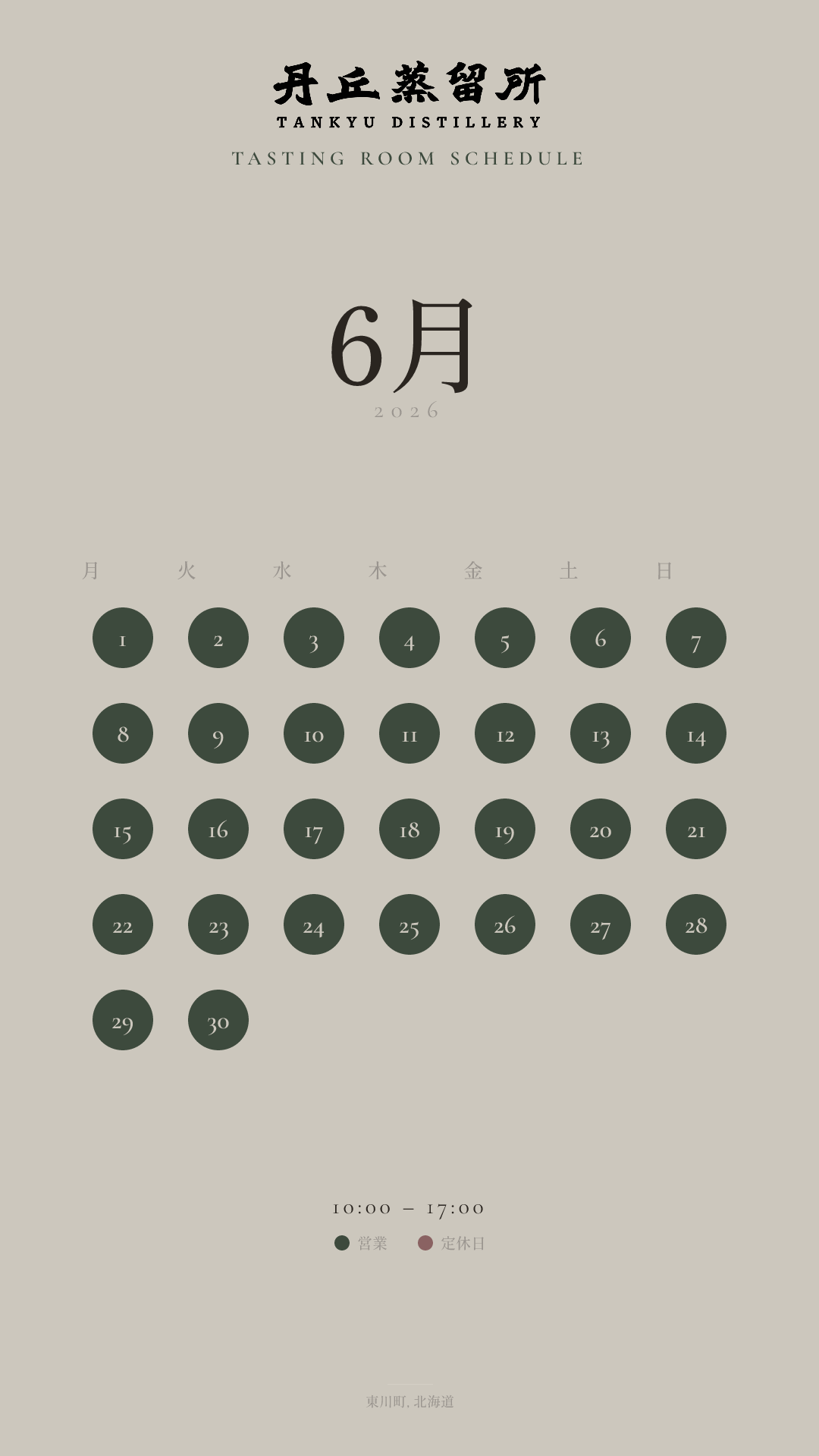
PinnedOpening schedule for June is published
Pinned
Opening schedule for June is published
PinnedMaster Distiller Blog No.01 — The Truth About Oak Casks
Why the ‘sherry casks’ in Scotch whisky are, almost never, what the name suggests — from oak species and cask formats to the Spanish export ban that quietly…
Pinned
Master Distiller Blog No.01 — The Truth About Oak Casks
Why the ‘sherry casks’ in Scotch whisky are, almost never, what the name suggests — from oak species and cask formats to the Spanish export ban that quietly…

Why the ‘sherry casks’ in Scotch whisky are, almost never, what the name suggests — from oak species and cask formats to the Spanish export ban that quietly rewrote a whole supply chain
By David Hsieh — Master Distiller, Tankyu Distillery | Presenter, Business Whisky Guide Podcast
Adapted from Business Whisky Guide Podcast EP1 — ‘50% + 50% = 200%? Let’s talk about oak casks,’ recorded in Scotland, January 2023.
INAUGURAL ISSUE | A NOTE FROM THE AUTHOR
Dear reader,
I am David Hsieh, master distiller at Tankyu Distillery.
For the past several years I have been working as a distiller at whisky distilleries in Scotland, sharing what I see from the still-house floor on the Business Whisky Guide podcast, Taiwan's #1 whisky podcast. In 2025 I joined Tankyu Distillery in Hokkaidō, Japan, where the work continues.
Beginning with this article, I will be writing in Tankyu’s Master Distiller Blog from a distiller’s point of view — on the history of whisky, on how it is made, on the present state of the trade, and on the small things you only notice once you are inside an operating distillery.
Welcome to the inaugural issue. We begin with the single vessel that decides more than half the flavour of any whisky: the oak cask.
There is a figure repeated by everyone in the trade, and it bears repeating here: between 50 and 80 per cent of the flavour of a single malt Scotch is given to it by the cask, in the long, slow conversation between oak and spirit. Raw materials, yeast and distilling regime are all important — none of them is trivial — but it is the years that follow, lying in oak, that determine the final shape of a whisky. Take a single batch of new-make spirit and decant it into different casks, and the bottlings that emerge years later may scarcely seem to belong to the same distillery. ‘Oak cask’, however, is not a single thing; species, provenance and prior life all matter, and behind each cask sits an entire supply chain.
The three great oaks: America, Europe, Japan
The three woods most commonly used for whisky casks differ by species, by latitude and by growing time, and each lends the spirit a different basic register.
American white oak (Quercus alba) grows chiefly in Tennessee, Mississippi and the surrounding states, where the swings between summer and winter encourage fast growth — about thirty years to harvestable maturity. The grain is straight, the wood splits cleanly, and the structure is tight enough that the cask will not weep spirit. It is, in short, the workhorse timber of cooperage. The vast majority of the ex-bourbon casks used by the Scotch whisky industry are American white oak.
European oak runs to two principal species: Quercus petraea (sessile oak), of which Hungary is now the chief source, and Quercus robur (pedunculate oak), grown in Spain and France — and the wood used for sherry casks. European oak takes far longer to mature, seventy to a hundred years, and the yield is correspondingly smaller. The wood carries higher tannins and lower lactone content than its American cousin, which is why European-oak whisky tends to read as spicier in character and firmer in structure.
Japanese oak is principally Quercus mongolica and Quercus crispula — the latter known to enthusiasts the world over as Mizunara. Japanese oak is scarce to begin with, and it grows as slowly as European — again seventy to a hundred years. The wood is brittle and notoriously difficult to work; but it carries a distinctive aroma all its own, and for that reason mature Mizunara casks are now treated as rarities.
Why bourbon casks took ninety per cent of the Scotch market
By American law, bourbon must be matured in new oak. Once a cask has held bourbon, it can never hold bourbon again. Those second-hand casks therefore have to go somewhere, and for decades that somewhere has been Scotland — which is why ninety to ninety-five per cent of all maturing Scotch today sits in ex-bourbon wood.
The casks arrive in Scotland either intact, as American Standard Barrels of around 200 litres, or knocked down into staves and shipped flat, to be reassembled at the receiving end into the larger hogshead format — about 250 litres. Other American whiskies, Tennessee whiskey among them, release casks of similarly suitable character; on labels these are often simply gathered under the broader heading of ‘American oak’.
The real story of the sherry cask
‘Sherry cask whisky’ sounds, on the face of it, like whisky matured in a cask that once held sherry. That description used to be accurate. It no longer is.
In an earlier era, when Britain was a great drinker of sherry, the bodegas of Jerez shipped their wine to Britain in 500-litre transport casks, where it was bottled on arrival. The empty casks were then bought up by Scottish distillers and pressed into service as maturation vessels for whisky. That is where the sherry-cask tradition originally comes from. Then, some fifty or sixty years ago, the Spanish government prohibited the export of sherry by the cask — it had to leave Spain in bottle — and overnight the old supply of casks fell away.
The whisky industry, undeterred, found a different route. It commissioned casks directly from Spanish coopers; the casks were ‘seasoned’ by being filled with sherry and left to stand for some months or years, after which the wine was drained and the empty cask shipped to Scotland. This is now, essentially, the way every modern ‘sherry cask’ is made. The supply chain has moved from salvaged transport casks to purpose-built seasoned casks; both are reflections of their time. For many bodegas, the revenue from making whisky casks has come to exceed the revenue from sherry itself.
The character of a ‘sherry cask’ will of course depend on which sherry sat in it. Fino, Manzanilla, Amontillado, Oloroso, Palo Cortado, Pedro Ximénez and Moscatel are all in use, but Oloroso dominates: oxidative, full-bodied, well-suited to whisky, it accounts for roughly ninety-five per cent of the sherry casks used in Scotch.
A cask has a life history: first-fill, refill, rejuvenated, STR
Casks can also be sorted by how often they have already been used. A first-fill cask still has most of its flavour compounds intact and gives them up generously to the spirit; the effect is almost as if the new make were steeping in a barrel of oak essence. A refill cask has had most of those compounds drawn out already and is better suited to slow maturation — much like a tea-bag on its second or third brew, where you wait longer to coax out what is left. When a cask has been used two or three times and the wood is exhausted, it can be rejuvenated: the inner surface is shaved back, then re-toasted, and the oak is, in effect, woken up again.
Taken a step further — shaved, toasted, then re-charred — you arrive at the STR cask, which can introduce wine-cask fruit character into new spirit at considerable speed. Kavalan in Taiwan has built much of its reputation on this format.
Cask finishing and the line between finishing and maturing
Cask finishing — the practice now widely fashionable — means moving a whisky, after the bulk of its maturation in a primary cask, into a second cask of a different kind for a relatively short stay, in order to add a layer of character. A few months in the finishing cask can do measurable work, at a fraction of the cost of full maturation in that wood; this widens the palette available to the distiller and the blender. It is not the same thing as long-term maturation in a single cask, and the two should be thought of as parallel approaches rather than one in place of the other.
The cask, then, is more than a container. From the species of the tree, through the prior life of the wood, to the shifting geographies of supply, each link in the chain leaves something behind. In the end, all of it shows up — slowly — in the glass.
About the author
David Hsieh is master distiller at Tankyu Distillery. He has previously worked as a distiller at several whisky distilleries in Scotland. He holds an MSc in Brewing and Distilling from Heriot-Watt University, and is the host and producer of the Business Whisky Guide podcast, Taiwan's #1 whisky podcast.
About the distillery
Tankyu Distillery is one of Japan's few public-private (公設民営) craft distilleries, located in Higashikawa, Hokkaido. The company was established in 2020, and the distillery opened in August 2025. It produces single malt whisky and craft gin using pristine spring water from the Daisetsuzan mountain range — water so pure that Higashikawa remains the only municipality in Hokkaido without a municipal water supply. Learn more at tankyudistillery.jp/en.
Source
・ Business Whisky Guide podcast EP1 — ‘50% + 50% = 200%? Let’s talk about oak casks,’ recorded in Scotland, January 2023. Original audio: youtu.be/28mr2CI7t9Y
PinnedYuki no Mado Dry Gin Wins Gold at the Tokyo Whisky & Spirits Competition 2026
Thank you, as always, for your continued support of Tankyu Distillery. We are proud to announce that Yuki no Mado Dry Gin has been awarded Gold at the Tokyo…
Pinned
Yuki no Mado Dry Gin Wins Gold at the Tokyo Whisky & Spirits Competition 2026
Thank you, as always, for your continued support of Tankyu Distillery. We are proud to announce that Yuki no Mado Dry Gin has been awarded Gold at the Tokyo…
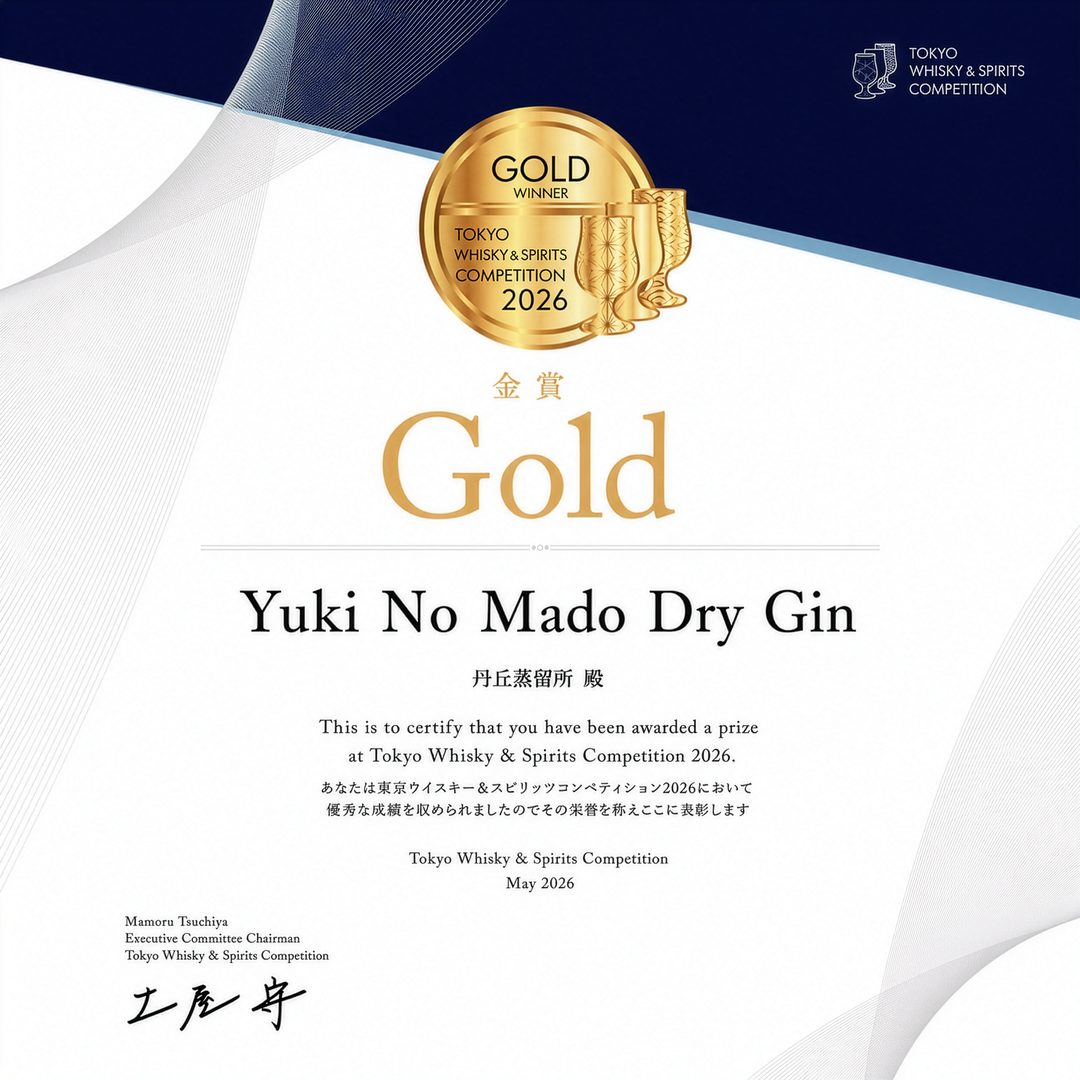
Thank you, as always, for your continued support of Tankyu Distillery.
We are proud to announce that Yuki no Mado Dry Gin has been awarded Gold at the Tokyo Whisky & Spirits Competition 2026 (TWSC 2026).
Our distillery officially opened last August. Time flies — ten months have already passed. For our debut gin to receive such an honour means a great deal to our whole team.
Yuki no Mado is a dry gin born in Higashikawa, Hokkaido, distilled with fourteen botanicals — Juniper, Rice Koji, Todomatsu (Hokkaido fir), Yuzu, and Lavender among them — together with snowmelt water from Mt. Asahidake in the Daisetsuzan range.
Finally, we extend our heartfelt thanks to the people of Higashikawa Town, and to everyone who has supported our distillery since the day we opened. This award is a very meaningful step forward for us, and we will keep crafting spirits that bring you joy.
- Buy online: shop.tankyudistillery.jp
- Product details: Yuki no Mado Dry Gin
Tankyu Distillery Co., Ltd.
PinnedService Restored — Our Apology and a ¥200-Off Coupon
Thank you, as always, for your continued support of Tankyu Distillery. We sincerely apologise for the recent disruption to our official website and online…
Pinned
Service Restored — Our Apology and a ¥200-Off Coupon
Thank you, as always, for your continued support of Tankyu Distillery. We sincerely apologise for the recent disruption to our official website and online…
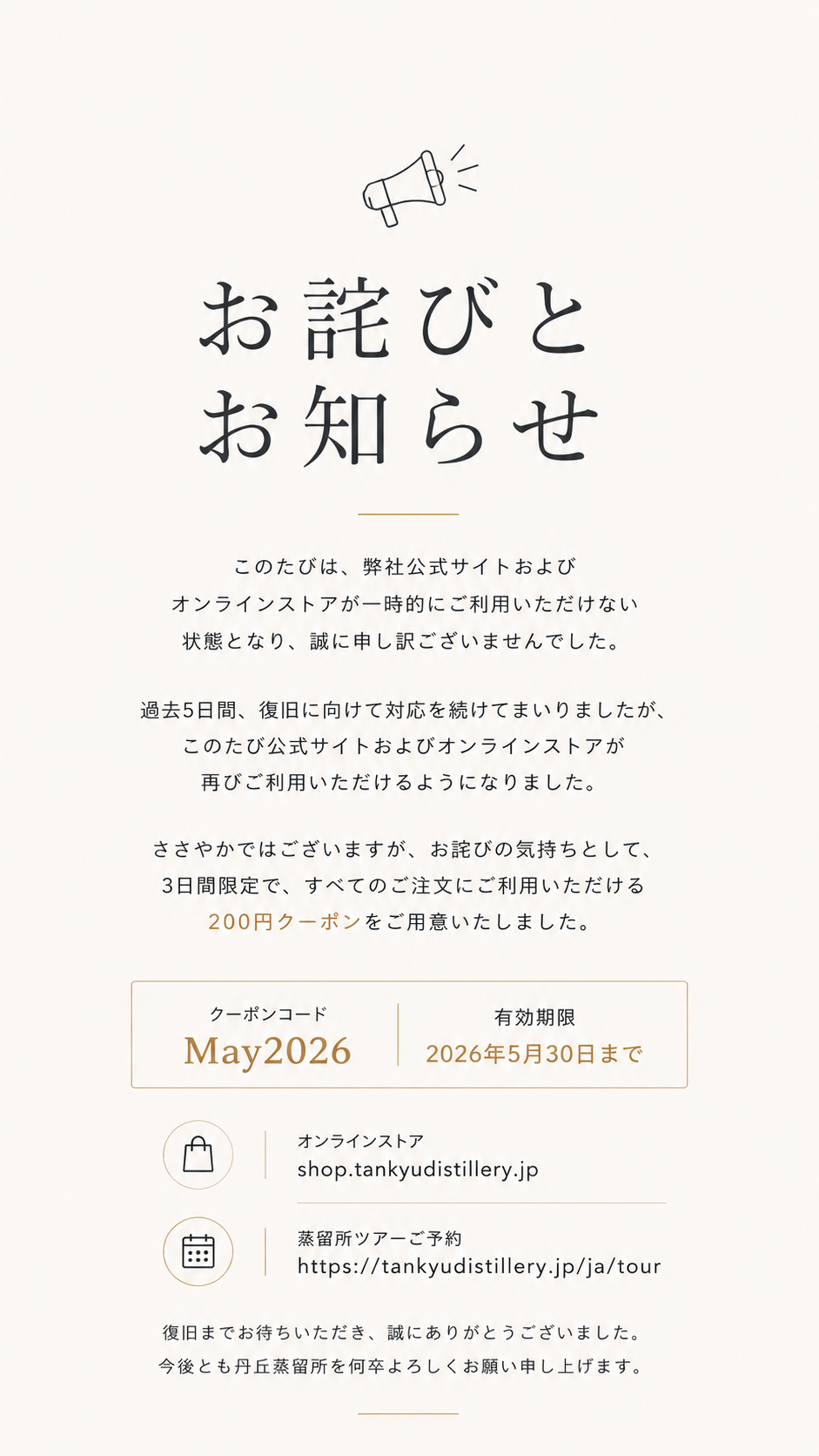
Thank you, as always, for your continued support of Tankyu Distillery.
We sincerely apologise for the recent disruption to our official website and online store, and for any inconvenience this may have caused.
Over the past five days our team has been working to restore service, and we are pleased to confirm that both the official website and the online store are once again fully available.
As a small token of our apology, we have prepared a ¥200-off coupon valid on all orders for three days, through 30 May 2026.
Coupon
Code: May2026
Discount: ¥200 off any order
Valid through: 30 May 2026
Where to use: shop.tankyudistillery.jp
Quick links
- Online store: shop.tankyudistillery.jp
- Distillery tour reservations: tankyudistillery.jp/en/tour
Thank you again for your patience while we restored service. We look forward to your continued support of Tankyu Distillery.
Tankyu Distillery Co., Ltd.
PinnedSingle Malt New Pot 2026 Released — 1,500 Bottles, the First Spirit from Tankyu Distillery
Today, Monday 11 May 2026, Tankyu Distillery releases Single Malt New Pot 2026 — our very first whisky bottling — in a strictly limited run of 1,500 bottles…
Pinned
Single Malt New Pot 2026 Released — 1,500 Bottles, the First Spirit from Tankyu Distillery
Today, Monday 11 May 2026, Tankyu Distillery releases Single Malt New Pot 2026 — our very first whisky bottling — in a strictly limited run of 1,500 bottles…
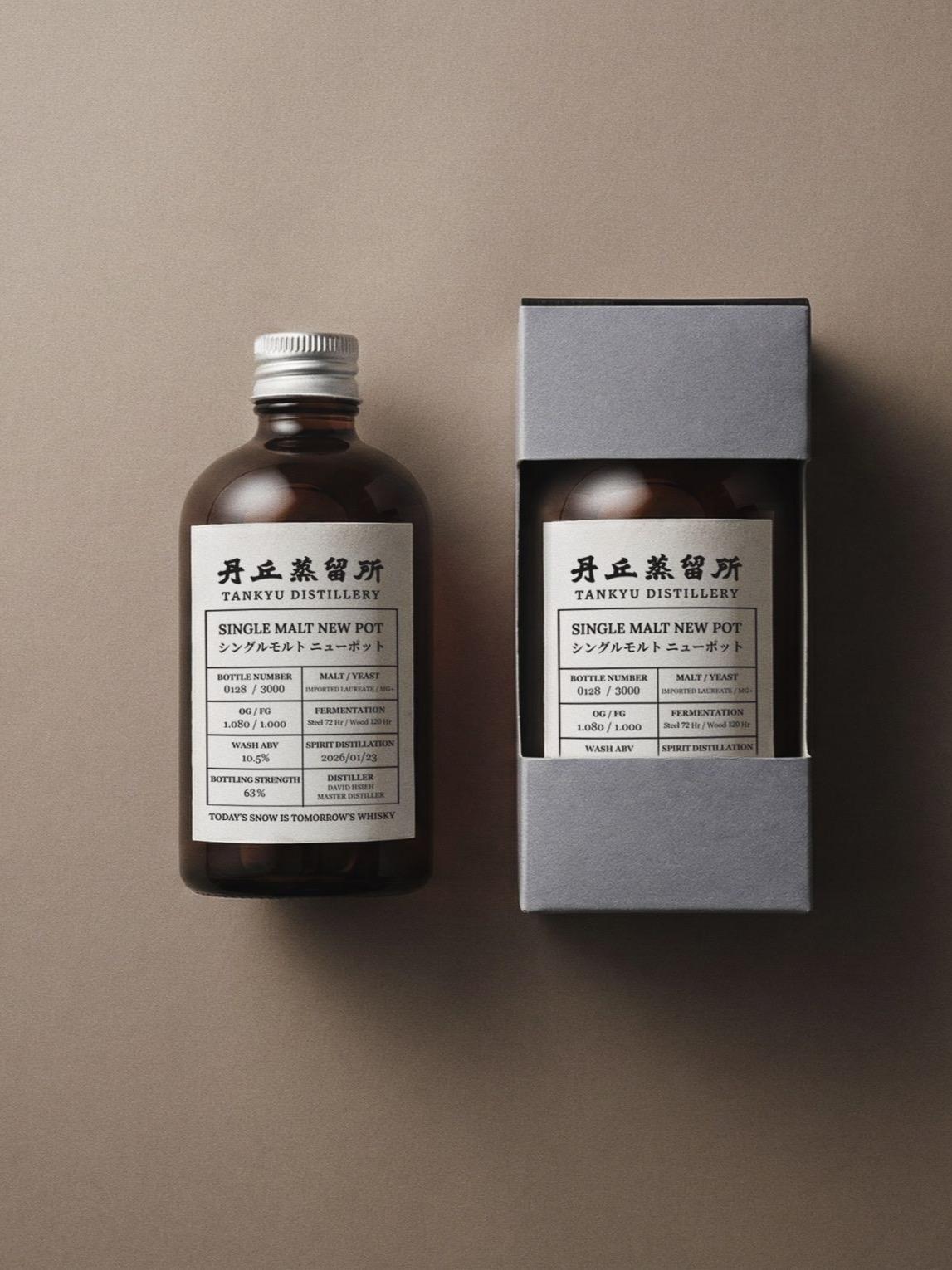
Today, Monday 11 May 2026, Tankyu Distillery releases Single Malt New Pot 2026 — our very first whisky bottling — in a strictly limited run of 1,500 bottles for the Japanese domestic market. 120 ml / 63% ABV / ¥2,970 incl. tax. Buy now at the Tankyu shop →
What is "New Pot"?
New pot is whisky spirit captured straight from the still, before any cask maturation. It is the purest possible expression of a distillery — the raw voice of the barley, the water, the fermentation, and the distillation philosophy, with nothing yet borrowed from oak.
This bottling is the overture to the Tankyu single malt that will follow. It lets you taste exactly where our whisky begins.
How it was made
- Malt: Scottish floor-malted barley (we use both UK and Japanese malt across batches)
- Water: Asahidake subterranean spring water from Higashikawa (one of the only towns in Japan with no municipal waterworks — the entire town is fed by Daisetsuzan groundwater) — used for both mashing and reduction
- Mashing: A rare mash filter (very few examples worldwide) extracts a richer, more concentrated wort than a traditional mash tun
- Fermentation: 168 hours across stainless-steel and wooden washbacks, producing the grape-like fruit aromatics that define the house style
Product specifications
| | | |---|---| | Product | Single Malt New Pot 2026 | | Volume | 120 ml | | ABV | 63% | | Edition | 1,500 bottles (Japan domestic only) | | Price | ¥2,970 incl. tax | | On sale | 11 May 2026 |
Tasting notes
Nose Rich malt rises first, followed by layered notes of toasted bread and cheese cracker. A soft minerality sits beneath, lifted by a gentle floral-honey sweetness.
Palate Bright and lively on entry, with fresh fruit sweetness drawn tight by a whisper of acidity. The malt core is firm and present; a creamy vanilla-ice-cream texture rounds the whole. Oily, substantial mouthfeel, with the faintest seaweed note for depth.
Finish Long and gently warming, with mulled wine, dried plum, and clove. A fine mineral thread runs to the very end, lending structure and complexity.
A note from Master Distiller David Hsieh
Tankyu's whisky production is led by Master Distiller David Hsieh, originally from Taiwan. He honed his craft as a distiller and blender at Scottish distilleries.
"Every decision we make in producing this new pot is made with the future single malt in mind. What is in the glass right now is the direction of the distillery itself. Grape-like fruit aromatics and the deep richness of malt, expressed plainly and directly — that is where our whisky begins."
About Tankyu Distillery
Tankyu Distillery opened in August 2025 in Higashikawa, Hokkaido — one of very few distilleries in Japan to operate under a public-private partnership model with its host town. We make gin and whisky at the foot of Daisetsuzan National Park, using the spring water that defines this place.
We also open the Private Cask Program 2026 cask-owner intake today. If you would like to mature your own Tankyu whisky, please take a look.
Master Distiller Blog No.11 — Inside the Mash Tun
How the working parts of a mash tun turn grist and hot water into sweet wort By David Hsieh — Master Distiller, Tankyu Distillery | Presenter, Business…
Master Distiller Blog No.11 — Inside the Mash Tun
How the working parts of a mash tun turn grist and hot water into sweet wort By David Hsieh — Master Distiller, Tankyu Distillery | Presenter, Business…
How the working parts of a mash tun turn grist and hot water into sweet wort
By David Hsieh — Master Distiller, Tankyu Distillery | Presenter, Business Whisky Guide Podcast
Adapted from Business Whisky Guide Podcast EP11 — ‘A Right Mess of Porridge (Part II)’.
This piece carries on from the last, turning to the mechanical workings of the mash tun itself.
The false bottom, and the bed that does the real work
At the foot of the mash tun lies a metal screen known as the false bottom, through which the wort is filtered. During mashing, though, it is not really the screen that does the filtering: it is the layer of husks that settles naturally on top of it, building up into a filter bed. That bed is where the wort is truly clarified.
Underletting: filling the gap first
Before mashing begins, the distiller performs a step called underletting — running a measured charge of hot water into the mash tun, just enough to cover the false-bottom screen. This water fills the void between the false bottom and the true base of the tun, so that the grist to come cannot wedge itself into the slots of the screen. Skip the step and the grist clogs the false bottom the moment it arrives, and the extraction rate and speed of the whole batch fall away sharply.
Through the mashing machine
Before grist and hot water enter the tun, they pass first through the mashing machine — shaped like a length of pipe laid on its side, with a screw running through it. Dry grist is fed in at the top, hot water at the bottom; the screw blades fold the two together and discharge them from the far end into the mash tun. The mashing machine usually holds the grist-to-water ratio at around 1:3 — too little water and the grist clumps; too much and the gravity of the wort suffers.
What the rakes are really for
Once grist and hot water have been delivered through the mashing machine, the distiller sets the rakes turning. They sweep slowly around the tun, but their purpose is not to stir the mash even — most of the mixing has already happened inside the mashing machine. What the rakes do is spread the grist evenly across the false bottom, building a husk filter bed of uniform thickness. If the bed is not laid level it heaps up near the inlet and thins out at the far end; and where the bed is uneven the wort runs off at different rates, so filtration falls away in patches.
Running off the wort
With the bed laid level and rested for some ten to thirty minutes, the distiller opens the valve at the base of the tun and lets the wort drain off under gravity. The level in the underback serves as the visual gauge for judging when the liquid in the mash tun has all been drawn.
Draff — and the rule every distiller learns once
Once all three worts are off, what remains in the tun is the solid residue: the draff. As a rule the mash tun has a draff port in its base, normally kept shut by a metal gate; to discharge, the gate is opened and the rakes restarted, and the arms push the draff towards the port, onto a conveyor and out to the draff lorry waiting outside, from where a farmer carts it off as feed for cattle and sheep. There is one iron rule here: before the rakes are started, you go outside and make sure the lorry is actually parked beneath the port. Miss that step and the entire batch of draff lands on the concrete floor — and the next two hours are spent shovelling tonnes of wet draff, spadeful by spadeful, back up into the truck bed. It is a mistake most distillers make exactly once, for the back will not straighten the following day, and the lesson goes in deep. Some mash tuns have no draff port at all, in which case the distiller really must pull on a pair of wellies, climb into the tun and dig the draff out by hand. At Edradour, the author once did precisely this as a matter of daily routine.
The mash tun is not, in itself, a complicated thing. Yet mashing is perhaps the stage a distiller watches more closely than any other in the making of whisky — and the one every distiller must take the most care to learn by hand.
About the author
David Hsieh is master distiller at Tankyu Distillery. He has previously worked as a distiller at several whisky distilleries in Scotland. He holds an MSc in Brewing and Distilling from Heriot-Watt University, and is the host and producer of the Business Whisky Guide podcast, Taiwan's #1 whisky podcast.
About the distillery
Tankyu Distillery is one of Japan's few public-private (公設民営) craft distilleries, located in Higashikawa, Hokkaido. The company was established in 2020, and the distillery opened in August 2025. It produces single malt whisky and craft gin using pristine spring water from the Daisetsuzan mountain range — water so pure that Higashikawa remains the only municipality in Hokkaido without a municipal water supply. Learn more at tankyudistillery.jp/en.
Source
・ Business Whisky Guide podcast EP11 — ‘A Right Mess of Porridge (Part II)’.
Other distilleries, brands and producers mentioned in this article are referenced on the basis of publicly available information and the author’s personal observation, in the spirit of information-sharing rather than commercial comparison or evaluation. The references do not represent the position of Tankyu Distillery.